Sri Lanka vs Bali: Which Is Better for a Holiday or Long-Term Stay?
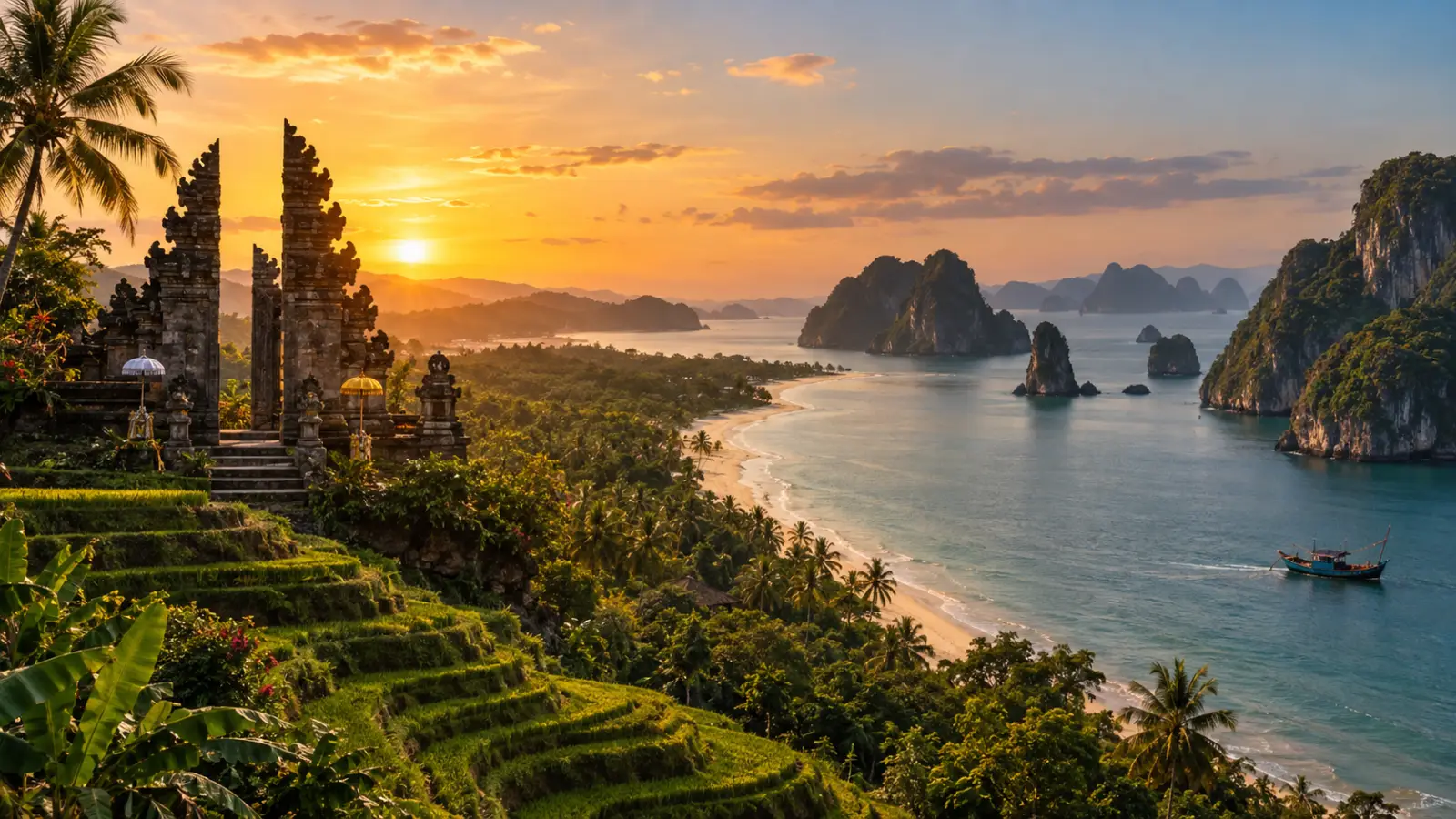
Sri Lanka and Bali are often compared as two similar tropical destinations: ocean, palm trees, surfing, exotic culture and relatively affordable living. In reality, they offer very different experiences. Bali is a relatively small Indonesian island and one of Asia’s most developed international lifestyle destinations. Sri Lanka is an independent island country with a much wider variety of landscapes, wildlife, historical sites and regions.
That difference becomes obvious as soon as you start planning a trip. In Bali, many of the main attractions can be combined within one island: Ubud, the southern beaches, volcanoes, waterfalls and nearby islands. A typical Sri Lanka trip feels more like a journey across a country, moving between the coast, national parks, tea plantations, mountains and ancient cities.
The useful question is therefore not which destination is universally “better”, but which type of holiday or lifestyle fits what you are looking for.
| Bali | Sri Lanka | |
|---|---|---|
| Best for | Surfing, villas, cafés, wellness, remote work and international social life | Road trips, wildlife, beaches, mountains, tea country and historical sites |
| Beaches | Excellent surf, fewer classic calm-water beaches | Very long coastline with many beach regions; best coast depends on season |
| Nature | Volcanoes, rice terraces, jungle, waterfalls | Mountains, tea estates, rainforest, dry-zone parks, beaches and national parks |
| Wildlife | Monkeys, marine life, birds and manta rays | Elephants, leopards, crocodiles, monkeys, whales and abundant birdlife |
| Culture | Highly visible Balinese Hindu culture in everyday life | Buddhist heritage, ancient cities, colonial history and regional diversity |
| Food | Huge international restaurant and café scene | Strong local cuisine, rice and curry, seafood and tea |
| Transport | Weak public transport; scooters and taxis dominate | Trains, buses, tuk-tuks, taxis and private drivers |
| Cost | Varies greatly; popular southern Bali has become expensive | Often cheaper outside premium resorts, although touring adds transport costs |
| Remote work | One of Asia’s most developed international remote-work ecosystems | Growing rapidly, with a dedicated Digital Nomad Visa now available |
| Long stays | VOA for eligible nationalities, C1 visitor visa and residence categories | ETA system, extensions and a one-year Digital Nomad Visa |
| Scale | Compact, although traffic makes journeys slow | A full-country itinerary usually requires several bases |
Bali is easier for a compact holiday; Sri Lanka works best as a journey
Bali is easy to understand as one destination. You can spend a few days in Ubud, move to Uluwatu, Sanur or Nusa Dua, and make separate trips to waterfalls, rice fields and volcanic areas. Distances appear short on a map, although congestion in southern Bali often turns 20 or 30 kilometres into a surprisingly long drive.
Sri Lanka works differently. Much of its appeal comes from moving between regions. Colombo and the west coast, the southern beaches around Mirissa and Unawatuna, Yala and Udawalawe national parks, the hill country around Ella and Nuwara Eliya, Kandy, Sigiriya and the ancient cities of the Cultural Triangle all create very different experiences.
That makes Sri Lanka particularly attractive to people who enjoy road trips and do not mind changing hotels every few days. It is certainly possible to spend two weeks at one beach, but doing so means missing a large part of what makes the country distinctive.
Bali is easier if you prefer to unpack, establish a base and take day trips. Sri Lanka is more rewarding if the journey itself is part of the holiday.
Sri Lanka has more beach variety; Bali has the stronger surf culture
The popular image of Bali often includes perfect tropical beaches, but the reality is more complicated. Many famous stretches of coast are attractive because of waves, cliffs, sunsets and surf rather than calm turquoise water.
Canggu, much of the west coast and many beaches around Uluwatu can have strong surf and currents. For more conventional swimming holidays, Sanur, Nusa Dua, Jimbaran and selected parts of the Bukit Peninsula are usually easier choices.
Sri Lanka has almost 1,600 kilometres of coastline. The south and southwest include Mirissa, Weligama, Unawatuna, Bentota and Tangalle, while the east has destinations such as Trincomalee, Pasikuda and Arugam Bay. There are busy resort areas, surf towns and long stretches of comparatively undeveloped coastline.
The important difference is seasonality. Sri Lanka’s coasts are affected by different monsoon systems, so the best beach region changes during the year. The south and southwest are generally at their best during the northern-hemisphere winter months, while the east coast becomes more attractive during much of the southwest monsoon season.
Both destinations are excellent for surfing, but the role of surfing is different. In Bali it has become one of the foundations of the island’s international tourism culture. In Sri Lanka it is more concentrated in specific areas, particularly Weligama and Arugam Bay.
Sri Lanka is in another league for wildlife and safaris
This is one of the clearest differences between the destinations.
Bali has monkeys, tropical birds, marine life and opportunities to see manta rays around Nusa Penida. Its landscapes are rich and varied, but the island is not a safari destination in the traditional sense.
Sri Lanka offers a completely different wildlife experience. National parks are home to wild elephants, crocodiles, buffalo, deer, monkeys and a remarkable variety of birds. Yala is particularly associated with leopards, while Udawalawe is famous for elephants. Whale- and dolphin-watching trips add another dimension along the coast.
Seeing a specific animal is never guaranteed — a national park is not a zoo — but wildlife can easily become one of the central themes of a Sri Lanka itinerary.
The quality of the experience depends heavily on the operator. Responsible safari companies should respect park rules and avoid chasing or surrounding animals simply to provide photographs. The same principle applies to elephant attractions elsewhere on the island: observing wildlife in a natural environment is very different from participating in entertainment based on captive animals.
Bali offers volcanoes and rice terraces; Sri Lanka has mountains and tea country
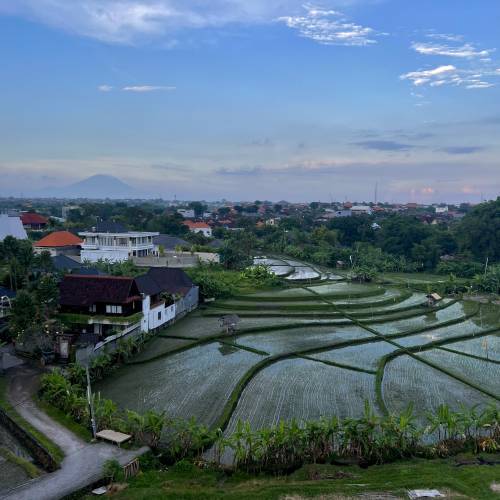
Bali’s landscapes are remarkably concentrated. In the centre of the island, rice fields, jungle, rivers and waterfalls sit close to temples and villages, while Mount Batur and Mount Agung create a completely different volcanic landscape.
The traditional subak irrigation system is especially important because it links agriculture, water temples and Balinese religious culture. The UNESCO-listed Cultural Landscape of Bali Province preserves this relationship between rice cultivation, water management and spirituality.
Sri Lanka has much greater changes in altitude and climate. The central highlands rise to more than 2,000 metres, and travelling from the hot coast to Ella or Nuwara Eliya can feel like entering another country.
Tea plantations, winding mountain roads, waterfalls and the railway through the hill country are among the island’s most recognizable experiences. Horton Plains, Adam’s Peak and the Knuckles Mountain Range add real trekking opportunities.
Sri Lanka also has eight UNESCO World Heritage Sites, combining ancient cities and monuments with natural areas. This makes it unusually easy to combine hiking and landscapes with historical travel.
Both destinations have strong cultures, but you experience them differently
Balinese culture is embedded in daily life. Hindu temples, household shrines, religious offerings and ceremonies remain visible even in heavily developed tourist districts.
Ubud is usually described as Bali’s cultural centre, but you encounter Balinese traditions almost everywhere. Nyepi, the Balinese Day of Silence, is the most dramatic example: for one day, normal movement and commercial activity across most of the island effectively stop.
Sri Lanka’s culture is more often experienced through a historical route. Sigiriya, Anuradhapura, Polonnaruwa, the cave temples of Dambulla and the Temple of the Tooth in Kandy create a very different kind of cultural journey.
The island also contains the colonial architecture of Galle, Hindu temples, Muslim communities and significant differences between Sinhalese and Tamil regions.
If you want to live continuously inside one visually distinctive culture, Bali has a particular strength. If ancient cities, archaeology and historical layers are more important, Sri Lanka offers more variety.
Bali has the simpler weather pattern
Bali lies close to the equator and has a relatively straightforward tropical climate. The drier period generally runs from roughly April to October, while November through March tends to be wetter.
Sri Lanka is more complicated because two monsoon systems interact with the central mountains. Looking at a single “Sri Lanka weather” forecast is therefore not very useful.
When the southwest coast is receiving heavier rain, the east can be significantly drier and calmer. During the northern-hemisphere winter, the south and southwest generally become the main beach regions.
This complexity is also an advantage. During much of the year, it is possible to choose a part of Sri Lanka with reasonably suitable conditions. You simply need to build the route around the season.
With Bali, the decision is simpler: choose the general period and then decide which part of the island fits your plans.
Bali has more international food; Sri Lanka keeps local cuisine closer to everyday life
Bali has become one of Asia’s strongest food destinations for an international audience. Canggu, Seminyak, Ubud and Uluwatu offer Indonesian food, Japanese restaurants, European bistros, specialty coffee, vegan menus, brunch cafés and contemporary fine dining.
That variety matters during a long stay. Even if you stop eating local food every day, you can maintain almost any familiar diet without much difficulty.
Outside Colombo and the most tourist-oriented coastal areas, Sri Lanka has a much smaller international restaurant scene. Local cuisine, however, remains much more dominant in everyday life.
Rice and curry is not one fixed dish but an entire style of meal combining rice with vegetables, dhal, coconut-based curries, fish or meat. Hoppers, string hoppers, kottu, seafood and tropical fruit add more variety, while Ceylon tea is naturally an important part of the country’s identity.
Sri Lankan cooking can be spicy, so travelers who prefer mild food should make that clear when ordering.
For international dining and café culture, Bali has the obvious advantage. For inexpensive local food and a stronger sense of eating within the local culture, Sri Lanka is equally interesting and often cheaper.
Accommodation and cost depend more on your lifestyle than the country name
Bali’s old reputation as an extremely cheap destination is increasingly misleading in its most popular areas.
Canggu, Uluwatu, Seminyak and desirable parts of Ubud have become significantly more expensive. A modern villa, international cafés, gyms, taxis and regular visits to beach clubs can quickly create a lifestyle that is far from budget travel.
There are still much cheaper areas, particularly if you eat locally and stay away from the most fashionable neighbourhoods.
Sri Lanka generally has a larger supply of inexpensive family-run guesthouses, small hotels and simple accommodation. In smaller towns and many coastal areas, prices can be noticeably lower than in Bali’s international hubs.
However, Sri Lanka introduces another major expense: moving around. Private drivers, safaris, entrance fees, long transfers and frequent hotel changes can raise the cost of an active itinerary considerably.
A month spent in one Sri Lankan beach town can be very affordable. A two-week trip covering half the island with multiple safaris and private transfers may not feel dramatically cheaper than Bali.
Bali has a much more developed villa market aimed specifically at international residents. Sri Lanka is stronger in guesthouses, small hotels and more conventional local rentals.
Transport in Sri Lanka is slower, but you have far more options
Bali has no railway and relatively weak public transport. For most visitors, realistic options are scooters, Grab, Gojek, conventional taxis or a car with a driver.
This is one of the island’s main practical weaknesses. Even short journeys in popular southern areas can take a long time because of congestion.
Sri Lanka is not a fast country to travel around either, but its transport system is much more varied. There are intercity buses, trains, tuk-tuks, taxis and private drivers.
Railways connect Colombo with Kandy, the hill country, the north and the east. The railway through the mountains between Kandy, Ella and Badulla has become an attraction in its own right.
Train travel is not necessarily fast. Mountain sections are slow, buses can be crowded and road journeys often take much longer than their distance suggests. Heavy rain and landslides can also temporarily disrupt roads or railway lines, especially in hill country.
For travelers who do not want to ride their own scooter, Sri Lanka is clearly easier. For flexible movement within one small area, a scooter remains extremely useful in Bali — assuming you have the correct licence, insurance and experience.
Bali has the more mature remote-work ecosystem, but Sri Lanka is catching up
Canggu and Ubud have been international remote-work centres for years. Coworking spaces, laptop-friendly cafés, entrepreneur events, fitness communities and a huge population of long-stay foreigners make it relatively easy to arrive alone and quickly build a social network.
This is one of Bali’s strongest advantages for digital nomads.
Sri Lanka does not yet have an international remote-work scene of the same scale, although parts of the south coast — particularly Ahangama and Weligama — as well as Colombo have developed quickly.
A major change is the introduction of Sri Lanka’s dedicated Digital Nomad Visa. The programme is designed for foreign remote employees, freelancers and business owners working for companies or clients outside Sri Lanka.
The official requirements include a minimum monthly remittance of US$2,000 for the principal applicant. The visa is valid for one year, and the immigration fee for the Digital Nomad category is US$500. Local employment is not permitted under the programme: the applicant must work remotely for foreign sources of income.
This changes the comparison considerably. Bali still has the stronger ready-made international ecosystem, but Sri Lanka now has a formal long-stay immigration route specifically designed for remote workers.
Entry rules now vary substantially by nationality
Visa information changes quickly, so travelers should always check the rules for the passport they actually intend to use.
Entering Bali and Indonesia
Indonesia’s B1 Visa on Arrival is available to citizens of a large list of eligible countries. It provides an initial stay of up to 30 days and can be extended once, allowing a total stay of up to 60 days. The standard VOA fee is IDR 500,000, and holders of an electronic e-VOA can extend eligible stays online.
For travelers planning a longer visit, Indonesia also offers the C1 Tourism Visitor Visa. It provides an initial stay of up to 60 days and can be extended several times up to a total of 180 days.
Foreign tourists visiting Bali should also account for the separate provincial tourist levy of IDR 150,000 per person. It is not a visa fee and applies independently of the immigration process, subject to the official exemptions.
Indonesia also offers longer-term residence categories for eligible applicants, including the E33G Remote Worker Special Residency Visa.
The correct option therefore depends on nationality, planned length of stay and purpose of travel.
Entering Sri Lanka
Sri Lanka operates an Electronic Travel Authorization system for short tourist visits.
From 25 May 2026, citizens of 40 countries — including Australia, Canada, China, France, Germany, India, Italy, Japan, the Netherlands, Russia, South Korea, Spain, the United Kingdom and the United States — became eligible for a tourist ETA free of charge for a 30-day stay. The free scheme includes double-entry within the 30-day validity period. Singapore and Seychelles also receive free 30-day tourist access under reciprocal arrangements, while Maldivian nationals receive 90 days.
Travelers from countries outside the free-ETA groups generally remain subject to the standard ETA fees and rules. The current official ETA portal instructs short-stay visitors to obtain their authorization before arrival, so the exact process should be checked immediately before travel.
Visitors who want to remain longer than their initial tourist period may apply for extensions, with the relevant fees and conditions applying.
For remote workers who meet the requirements, the one-year Digital Nomad Visa now provides a much clearer route for long-term residence than repeated tourist extensions.
Healthcare depends heavily on where you stay
Bali’s main tourist areas have numerous private clinics, dental practices and hospitals accustomed to foreign patients. For routine medical issues, the available care is generally sufficient.
For more complex specialist treatment, the choice is naturally narrower than in a major Asian capital because Bali remains one island.
Sri Lanka has a similar geographic divide. The strongest medical infrastructure is concentrated in Colombo and other large cities. Small beach towns and hill-country destinations naturally have fewer specialists and facilities.
For a short holiday, this difference is rarely decisive. For someone with a chronic condition or anyone planning to stay for a long period, proximity to a major hospital becomes much more important.
International or travel health insurance is advisable in both destinations, especially if it includes private hospitalization and medical evacuation.
Everyday risks are more about roads, the ocean and nature than dramatic headlines
Older travel comparisons of Sri Lanka sometimes devote disproportionate attention to the 2019 terrorist attacks. For a practical comparison in 2026, that does not reflect the risks most travelers are likely to deal with day to day.
In both destinations, more ordinary concerns include road accidents, petty theft, scams, dangerous ocean conditions and traveling without adequate insurance.
In Bali, dense traffic and strong ocean currents deserve particular attention. Renting a scooter without the proper licence or sufficient experience can turn an otherwise simple holiday into a serious problem.
In Sri Lanka, road travel can involve long mountain journeys, while heavy seasonal rains occasionally affect transport. Wildlife also requires common sense: a wild elephant beside a road or inside a national park is not a tourist prop, and approaching animals for photographs can be dangerous.
Both destinations are widely travelled and generally manageable for independent visitors using normal precautions.
What works better for a one- or two-week holiday?
Bali is easier for a compact holiday.
In one or two weeks, you can divide your time between two areas, visit temples and rice terraces, see a volcano, spend several days on the coast and still avoid using a large portion of the trip for long-distance transport.
This format works particularly well for people who want to alternate sightseeing with relaxed days by the pool, in cafés or at the beach.
Sri Lanka is better approached as an itinerary. In two weeks, for example, you could combine the Cultural Triangle, Kandy, Ella, a national park safari and several days on the south coast.
The range of experiences is broader, but the amount of moving around is also greater.
If most of the holiday should involve relaxing in one comfortable area and taking occasional day trips, Bali is simpler. If you want to wake up in a different landscape every few days — ancient ruins, tea country, wildlife parks, mountains and ocean — Sri Lanka provides the more varied journey.
What works better for living for several months?
For longer stays, the difference becomes even clearer.
Bali offers a ready-made international lifestyle infrastructure: villas and apartments, cafés, gyms, coworking spaces, surf schools, yoga, wellness, international restaurants and a huge expatriate population. This is particularly concentrated around Canggu, Ubud and the Bukit Peninsula.
The disadvantages are equally established: congestion, dependence on scooters or taxis and increasingly high prices in the most fashionable areas.
Sri Lanka generally offers a quieter environment. The south coast provides ocean living, the central highlands offer mountains and cooler weather, while Colombo gives access to a more conventional urban lifestyle.
The international community is smaller and less concentrated than in Bali, but many places also feel less separated from normal local life.
The introduction of the one-year Digital Nomad Visa has significantly improved Sri Lanka’s position for long-term remote workers. A person earning abroad and meeting the income and documentation requirements can now use a formal residence route rather than relying only on tourist extensions.
For a stay of several months, the choice therefore depends less on which country is cheaper and more on the environment you want. Bali is stronger for a highly developed international social scene and ready-made lifestyle services. Sri Lanka is stronger for a quieter base combined with road trips, wildlife, mountains and a less concentrated tourism environment.
Sri Lanka or Bali: how to choose
Choose Bali if your priorities are:
- surfing and a mature surf culture;
- a compact island that can be explored in sections;
- villas, cafés, yoga, fitness and wellness;
- a large international community;
- one of Asia’s most developed digital-nomad environments;
- a huge choice of international food;
- Balinese culture as part of daily life;
- living in a highly developed tourism ecosystem with familiar services.
Choose Sri Lanka if your priorities are:
- a road trip with frequent changes of scenery;
- safaris and wild animals;
- ancient cities and Buddhist heritage;
- tea plantations, mountains and scenic railway journeys;
- a very long coastline with different beach seasons;
- a quieter and less concentrated tourism environment;
- the possibility of free 30-day tourist ETA access if your nationality is among the eligible countries;
- a one-year Digital Nomad Visa if you meet the requirements.
The main mistake is treating Sri Lanka and Bali as two almost interchangeable tropical islands.
Bali is primarily a concentrated lifestyle destination: surfing, cafés, villas, wellness, international social life and the ability to build a comfortable tropical routine relatively quickly.
Sri Lanka is more of a journey through a country. Its strongest experiences often happen while moving: the ocean gives way to wildlife parks, then tea-covered mountains, ancient Buddhist cities and finally a completely different coast.
For a first relaxed tropical holiday, Bali is usually easier to organize. For a more active trip built around wildlife, history, mountains and changing scenery, Sri Lanka offers greater variety. For living several months, Bali still has the stronger ready-made international infrastructure, but Sri Lanka’s new Digital Nomad Visa makes it a much more serious alternative for remote workers than it was only a few years ago.
Updated: September 2026. Visa rules, transport conditions and seasonal weather patterns can change. Always verify requirements for your passport, current route conditions and regional weather through official sources before travelling.
Comments
Read also
All articles
10 Bali Beach Clubs: Where to Go for Sunsets, Pools and Parties
Potato Head, KU DE TA, FINNS, Atlas, La Brisa and five more clubs: individual photos, atmosphere, locations, entry rules and booking advice.

Bali vs Mauritius: Which Is Better for a Holiday or Long-Term Stay?
Bali and Mauritius often appear on the same list of tropical destinations: ocean, palm trees, beaches, warm weather and the possibility of spending several weeks…
About the seasons on the island, when is it better to fly to Bali
It is believed that Bali has 2 seasons: dry and wet. Dry lasts approximately from April to October. At this time, there is almost no…

Responsible consumption: what we leave behind
Keeping things useful, buying fewer unnecessary items and passing possessions on are everyday ways to care for our surroundings and future generations. How to make…
Indonesia Entry Rules for Bali in 2026
An up-to-date Bali entry guide for travellers of different nationalities: visa-free entry, VOA/e-VOA, visas before travel, All Indonesia and the Bali tourist levy.
Where to post an ad in Bali: how to sell an item, offer a service or find clients
Life in Bali constantly creates situations where you need to offer something to other people.