12 October 2026 marks 24 years since the tragedy that changed the history of modern Bali. On the night of 12 October 2002, explosions struck Kuta, a busy tourist area near popular venues on Jalan Legian. 202 people were killed and another 209 were injured. The victims included citizens of Australia, Indonesia and more than twenty other countries.
This is not a breaking-news story and the memorial should not be treated as a backdrop for a striking photograph. It is a place of remembrance for the people who died, the survivors, their families and everyone who helped in the first hours after the explosions.
What happened on 12 October 2002
At about 11 pm, three explosive devices were detonated. Two blasts occurred in Kuta’s busiest tourist quarter: the first inside Paddy’s Pub and the second in a vehicle parked outside the Sari Club. A third explosion took place near the United States consulate in Denpasar. The location, timing and number of people in the area made the consequences catastrophic.
The National Museum of Australia records that the first explosion was caused by a suicide bomber in Paddy’s and that the second device was in a van outside the Sari Club. Australian government commemorative material gives the final toll as 202 dead and 209 injured. It also records 88 Australians and 38 Indonesians among those killed. Indonesia’s tourism ministry describes the Ground Zero memorial as commemorating people from 22 countries.
The attack has been attributed to Jemaah Islamiyah, a regional extremist organisation with links to an international terrorist network. The original version of this article reduced the motive to Australia’s involvement in military operations. That is too simple and creates a false sense of certainty. It is more accurate to describe the event as a terrorist attack investigated by Indonesian and international agencies, followed by stronger cooperation between countries.
Why so many nationalities were affected
In 2002, Kuta was one of Bali’s busiest tourist districts. On a Saturday night, travellers from many countries, local residents and people working in bars and clubs were sharing the same streets. Some were on holiday, some were meeting friends, and others were simply passing by. The attack did not affect one single tourist group: the victims came from different countries and backgrounds.
Australia suffered the largest national loss, with 88 people killed. Bali had long been a familiar destination for Australians, so the tragedy affected families, sporting clubs and entire communities. But it would be wrong to remember the bombing only as an Australian-Indonesian story. The memorial lists the names and nationalities of people from many countries.
How people responded after the explosions
The first hours revealed not only the scale of the destruction but also the courage of ordinary people. Local residents, hotel employees, security guards, drivers, venue staff and tourists helped search for the injured, move people away from danger, contact hospitals and look for those who could not be reached.
Doctors and nurses in Bali worked under the pressure of a mass casualty event. Some of the most seriously injured were later evacuated to Australia for treatment, including to Darwin and Perth. The Australian Federal Police sent specialists to assist with victim identification and the investigation, while government and medical services from both countries began working more closely together.
This part of the story matters as much as the crime itself. The National Museum of Australia notes that almost 200 Australians later received special honours for bravery or assistance after the bombings. They included emergency workers and ordinary people who stayed with survivors when the situation was at its worst.
Where to find the Ground Zero memorial
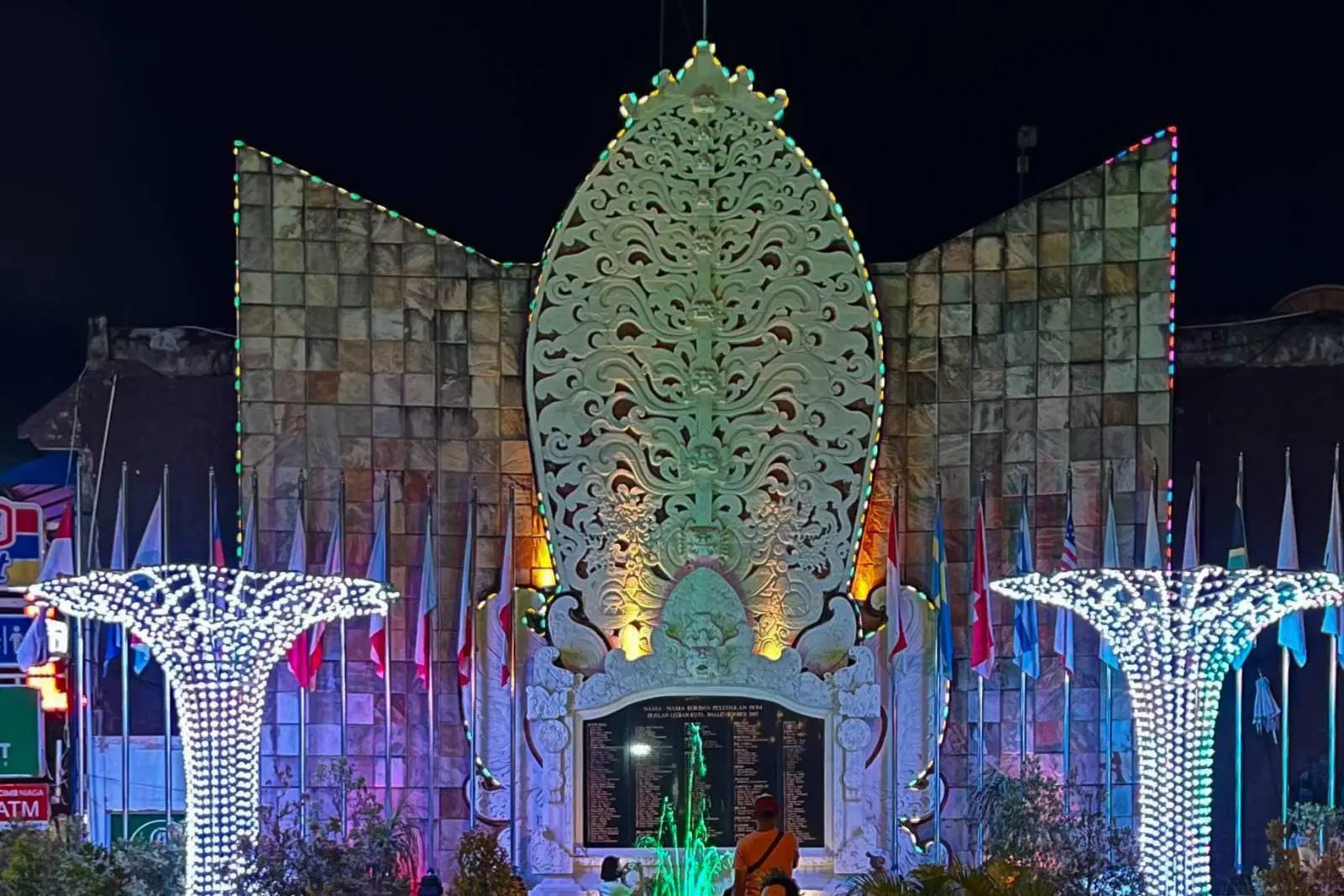
The Ground Zero memorial, also known as Monument Bom Bali I, stands on Jalan Legian in Kuta, near the former sites of Paddy’s Pub and the Sari Club. It is not a museum or an entertainment attraction. The monument carries the names and nationalities of those who died. Its form resembles the Balinese gunungan, an image from traditional shadow theatre associated with the structure of the world.
Indonesia’s official tourism portal describes Ground Zero as a place where annual commemorations are held and as a reminder of peace and tolerance. If you pass by, behave quietly: do not block access to the monument, do not photograph people without consent, do not turn a ceremony into entertainment, and respect families for whom this remains a personal place of grief.
You do not need to make a special trip to the memorial. But if you are staying or walking in Kuta, you can pause for a few minutes and read the names. It is a way to see the district not only as a place of nightlife, restaurants and shops, but also as a place with a difficult history.
What changed after the tragedy
After the bombings, Australia and Indonesia expanded cooperation on transnational crime, counter-terrorism, disaster victim identification and medical care. Australia’s Bali Memorial Package helped improve medical infrastructure in Bali. One result was the 12 October Australian Memorial Centre Burns Unit at Prof Ngoerah Hospital in Denpasar. The hospital continued professional cooperation with Australian medical organisations.
Remembrance gradually became more than mourning. It also became treatment for burns and trauma, professional training, support for survivors and relatives, and better preparation for emergencies. This is one of the tragedy’s practical lessons: the safety of a tourist destination depends not only on police, but also on hospitals, communications, transport, trained staff and the ability of different countries to act together.
Twenty-four years later
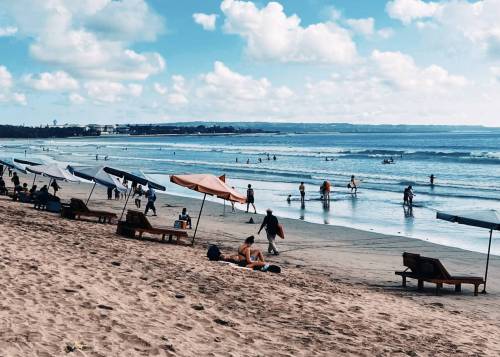
In 2026, Bali remains one of Indonesia’s main tourist destinations and Kuta is again full of everyday life. That does not erase the past. It shows that memory and ordinary life can exist side by side: streets continue to function, families continue to travel, and the names of those killed remain on the memorial.
As the 24th anniversary approaches, it is especially important to use accurate figures and not mix the 2002 and 2005 attacks. This article concerns the first attack on 12 October 2002: three explosions, 202 deaths, 209 injuries and victims from 22 countries. The later attack on 1 October 2005 was a separate event and should not be included in this toll.
For me, the memorial on Jalan Legian is a reminder that Bali is more than beaches, temples and nightlife. The island also has difficult pages in its history. They should be remembered without sensationalism, with respect for the dead and survivors, and with the hope that such a tragedy will never happen again.
Sources: Indonesia Ministry of Tourism — Ground Zero Memorial; National Museum of Australia — Bali bombings; Australian Government — 20th anniversary remarks; Australian Government — Bali Memorial Package report.